
JACOBIN MAGAZINE
“There is not a liberal America and a conservative America — there is the United States of America. There is not a black America and a white America and Latino America and Asian America — there’s the United States of America.”
– Barack Obama, 2004 DNC address
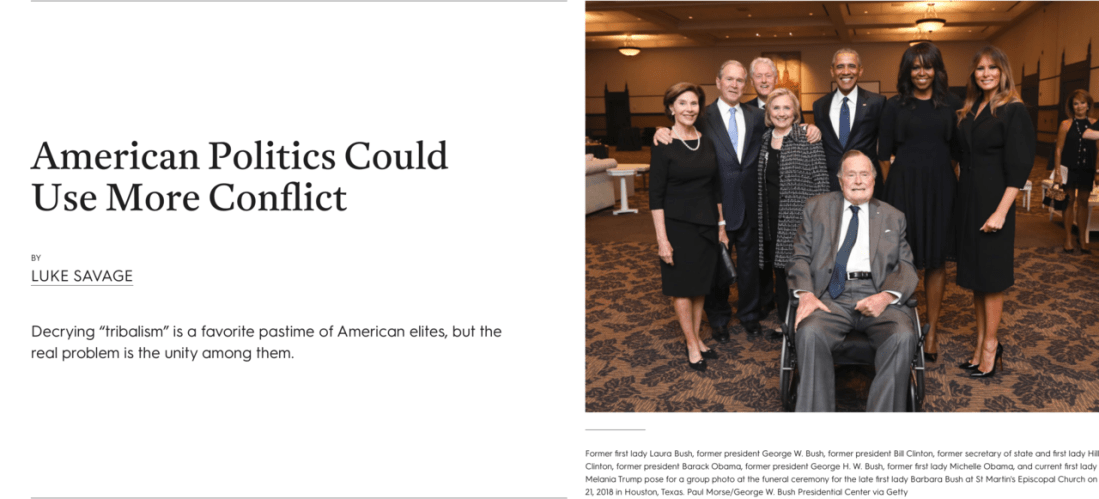
“What if we were wrong? Maybe we pushed too far. Maybe people just want to fall back into their tribe.” These were the words reportedly spoken by Barack Obama to aides shortly after the 2016 presidential election.
Uttered on this particular occasion, Obama’s world-weary remark was most certainly that of an outgoing president frustrated in defeat. But I believe it was also the earnest expression of an ideology he shares with many of Washington’s most powerful and influential figures, whatever their professed party allegiance: namely, that there is a phenomenon called “tribalism” (or alternatively, “partisanship”) that is needlessly dividing the country and obstructing progress — a march towards some common interest that presumably consists of its negation.
In this telling, “tribalism” is a kind of Rosetta Stone for decoding what ails American democracy. And if it can be transcended, a Big Rock Candy Mountain of political harmony and national reconciliation awaits the pragmatic pilgrims of our post-partisan tomorrow. (We would be remiss here, I think, not to acknowledge the term’s sinister racial connotations, which I don’t believe are entirely accidental.)
By my estimation, no other single narrative has quite the same hold on the political imaginations of mainstream commentators, politicians, and pundits. Some mostly cosmetic liberal or conservative texturing aside, it’s one that is remarkably prevalent among two factions with supposedly intractable differences.
Various incarnations of it are absolutely everywhere and have been for as long as most of us can remember. As I’ve noted elsewhere, it was the central theme of the speech that made Obama a national figure and would remain a preoccupation of his presidency to the very end. During the Tea Party revanchism that followed the 2008 election, it was the key refrain of Jon Stewart’s “Rally to Restore Sanity.” Throughout 2015 and 2016, it also united sections of both party establishments in their collective disgust at Donald Trump and informed Hillary Clinton’s ill-fated courtship of suburban Republican voters. During the Bush presidency, calls for liberals to put their partisanship aside and heed the national interest (in that case, approving torture and dropping more bombs on various parts of the Middle East) were common. And decades before today’s panicked warnings about “identity politics,” conservative pundits and public intellectuals were issuing all-too-similar pronouncements about looming polarization and the “divisiveness” ostensibly represented by antiwar protesters, feminists, LGBTQ activists, and civil rights.
But if this narrative was popular in a pre-Trumpian Beltway, its various manifestations and those of its accompanying fables are enjoying a veritable renaissance in a post-2016 one.
Among other things, David Frum’s bestselling book partly accounts for the Trump presidency by decrying the two major parties’ failure to compromise and find common ground. Faced with a majority Republican Senate bent on pushing through its destructive, plutocratic agenda at all costs, Chuck Schumer has taken to complainingabout the lack of inter-party cooperation when it comes to cutting taxes and periodically suggesting he may help fund Trump’s infamous border wall. No sooner had the Democrats been declared the winners of this month’s midterm elections and Nancy Pelosi was already preaching the “bipartisan marketplace of ideas” and talking vaguely of unity in place of the more aggressive, adversarial strategy many Democratic voters would undoubtedly like to see.
A version of the tribalism thesis has also been advanced in a new book by Yale law professor Amy Chua, which worries that Americans have started turning away from their institutions amid “seismic demographic change … declining social mobility, a growing class divide; and media that rewards expressions of outrage.” For Chua, as for so many of the thesis’s like-minded exponents, the solution lies in a renewed spirit of constitutional unity to be found somewhere in between the demands made by right and left (or, at any rate, caricatures of them):
The right needs to recognize that making good on the Constitution’s promises requires much more than flag-waving. If millions of people believe that [emphasis mine] because of their skin color or religion, they are not treated equally, how can they be expected to see the Constitution’s resounding principles as anything but hollow? For its part, the left needs to rethink its scorched-earth approach to American history and ideals. Exposing injustice, past and present, is important, but there’s a world of difference between saying that America has repeatedly failed to live up to its constitutional principles and saying that those principles are lies or smoke screens for oppression.
(Continue Reading)
 Sebastion Cooper